
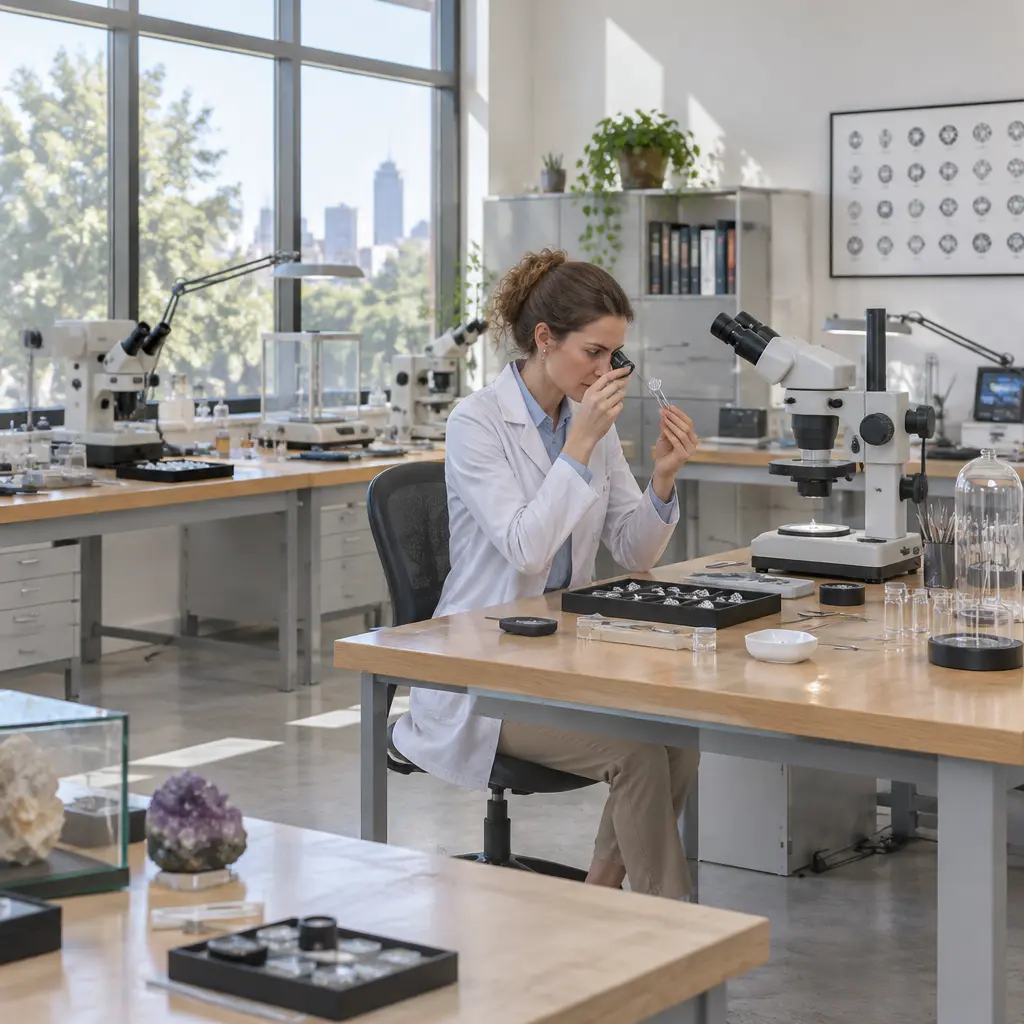
Lab-Grown Authenticity Comparing Chemical Structure Against Mined Diamond Equivalents
Lab-grown diamonds have the same defining crystal structure and principal chemical composition as mined diamonds: both are crystalline carbon, with carbon atoms arranged in a three-dimensional diamond lattice. The Federal Trade Commission and gemological laboratories distinguish them by origin, not by a different basic chemical identity. Their growth histories can leave detectable differences in trace elements, inclusions, growth patterns, or defects, so gemologists can often identify whether a diamond was grown in a laboratory. Understanding that distinction matters to buyers: in 2023, laboratory-grown diamonds represented about 10% of U.S. engagement-ring center stones by unit share, according to industry research, while their prices and market positioning continued to change rapidly. This article compares structure, production, testing, value, and disclosure—and explains why “chemically alike” does not mean “identical in every measurable feature.”
Chemical Structure and Lab-Grown Diamond Authenticity
A diamond is a crystalline form of carbon in which each carbon atom is bonded to four neighboring carbon atoms in a tetrahedral arrangement. The same bonding pattern and crystal structure occur in natural and laboratory-grown diamonds. The Gemological Institute of America (GIA) describes laboratory-grown diamonds as having essentially the same chemical, physical, and optical properties as natural diamonds, while emphasizing that their origins differ.
Here, “authentic” refers to whether a stone is genuinely diamond rather than an imitation such as cubic zirconia or moissanite. “Natural” and “laboratory-grown” describe how a diamond formed. A lab-grown diamond is a real diamond, but it is not a mined diamond; a simulant may resemble diamond but has a different composition or crystal structure. This distinction is central to accurate buying, grading, and disclosure.
Crystal Structure and Diamond Composition
The entity-attribute pairing at the center of this comparison is diamond crystal structure: the arrangement of atoms that gives diamond its characteristic physical properties. The American Gem Society identifies diamond as crystallized carbon, and the GIA explains that its carbon atoms form a cubic crystal structure. Hardness, light behavior, and thermal conductivity are consequences of that structure, although impurities and defects can alter some measured properties.
The main categories relevant to this topic are natural diamonds, laboratory-grown diamonds, and diamond simulants. Natural diamonds form through geological processes; lab-grown diamonds are produced through controlled industrial processes; simulants imitate appearance without being diamond. The first two share diamond’s core lattice, whereas simulants do not. That connection leads to an important qualification: matching the basic lattice does not erase the microscopic evidence of a stone’s growth history.
Carbon Lattice and Physical Properties
In diamond, each carbon atom shares electrons with four neighboring atoms, creating a rigid three-dimensional network. This arrangement accounts for diamond’s exceptional hardness and its ability to conduct heat efficiently. Both natural and laboratory-grown diamonds can display the same characteristic brilliance, fire, and hardness because these properties arise primarily from the diamond lattice rather than from whether the crystal was mined.
A gemological comparison should therefore separate identity from origin. A stone can test as diamond while still requiring further examination to determine whether it grew underground or in a reactor. Conversely, visual similarity alone is not proof: moissanite, for example, can resemble diamond but is silicon carbide, not crystalline carbon.
Trace Elements, Inclusions, and Defects
Trace nitrogen, boron, and other impurities, as well as crystal defects and inclusions, can influence a diamond’s color and provide clues to its formation. Natural stones may contain mineral inclusions and growth features associated with geological conditions. Laboratory-grown stones can show metallic flux inclusions or growth patterns associated with high-pressure, high-temperature production, or features associated with chemical vapor deposition. These clues are not universal, and a single feature should not be treated as conclusive without appropriate testing.
The International Gemological Institute and GIA use advanced gemological instruments to examine such features. The relevant evidence is not that every lab-grown stone has a visible mark, but that growth-related characteristics may be detectable even when the stone looks identical to a mined diamond to the unaided eye.
Growth Methods and Origin Signatures
Laboratory-grown diamonds are chiefly made by high-pressure, high-temperature (HPHT) methods or chemical vapor deposition (CVD). HPHT recreates conditions of high pressure and temperature that enable diamond crystal growth; CVD deposits carbon-containing material from a gas mixture onto a substrate in a vacuum chamber. Both methods produce diamond, but their different growth environments can leave distinct patterns, inclusions, or defect signatures.
Natural diamond formation typically takes place deep in Earth over geological timescales, with crystals later carried toward the surface by volcanic eruptions. Lab-grown production instead takes place in controlled equipment over weeks or months, depending on the growth process and crystal size. The shared endpoint is a diamond lattice; the differing pathways explain why origin can be identified through spectroscopy and imaging.
HPHT and CVD Diamonds
HPHT diamonds grow under conditions designed to reproduce the pressure and temperature needed for diamond crystallization, commonly using a metal catalyst. CVD diamonds grow as carbon-containing gases break down and carbon atoms deposit layer by layer on a diamond seed. Each approach can yield gem-quality material, and both may require post-growth treatment to improve or modify color.
Growth method is not a reliable visual label for consumers: polished HPHT and CVD stones can look much like mined diamonds. Laboratories may use fluorescence imaging, spectroscopy, and other instruments to assess growth patterns and treatment indicators. As a result, a grading report’s origin description is more dependable than appearance alone.
Natural Formation and Geological Context
Natural diamonds formed under high-pressure conditions in Earth’s mantle and were brought closer to the surface by kimberlite and related volcanic rocks. The Smithsonian National Museum of Natural History notes that many diamonds are extremely old, with formation ages commonly measured in billions of years. Their inclusions and growth zoning can preserve information about the deep Earth, making diamonds scientifically valuable as well as commercially prized.
This geological history contrasts with controlled laboratory growth, but age or origin does not determine whether a stone is chemically diamond. It does, however, affect how a stone should be described, documented, and evaluated in the marketplace.
Testing and Verification of Diamond Authenticity
Diamond verification involves two related questions: is the material diamond, and is it natural or laboratory-grown? Basic testers can help distinguish diamond from some simulants by measuring thermal or electrical behavior, but they may not establish origin. Separating natural from lab-grown often requires laboratory instruments that examine optical and spectroscopic responses, growth structures, and defects.
The GIA and other gemological laboratories issue reports that identify a stone’s characteristics and, where determined, its growth origin. A report is an assessment rather than a guarantee of future market value. Buyers should match the report number to any laser inscription on the stone, when present, and confirm that the document corresponds to the item being sold.
Gemological Instruments and Laboratory Reports
Professional laboratories may combine microscopy, ultraviolet fluorescence imaging, infrared absorption, photoluminescence, and other analytical techniques. These methods detect patterns linked to growth conditions and impurity profiles. Because characteristics can overlap and treatments can complicate interpretation, trained gemologists consider multiple observations rather than relying on one test.
A grading report typically records characteristics such as carat weight, color, clarity, and cut-related assessments, alongside the laboratory’s determination of natural or laboratory-grown origin. Reports from different organizations may use different formats and terminology, so consumers should read the origin statement and treatment disclosures rather than relying only on a grade summary.
Disclosure and Consumer Protection
The U.S. Federal Trade Commission’s Jewelry Guides state that marketers should clearly and conspicuously disclose that a product is laboratory-grown, laboratory-created, or another accurate equivalent when it is not mined. The guidance also cautions against using “real,” “genuine,” or similar wording in a way that misleads consumers about origin. The practical rule is straightforward: describe the stone as a diamond and clearly state whether it is laboratory-grown or natural.
Clear disclosure protects buyers from confusing a lab-grown diamond with either a mined diamond or a simulant. It also makes comparisons fairer: two stones may share the same basic chemistry but differ substantially in origin, rarity, price, and resale demand.
Market Context, Pricing, and Real-World Implications
The market has expanded as production technology improved and consumers sought alternatives at different price points. The Knot’s 2023 Real Weddings Study reported that laboratory-grown diamonds accounted for about 10% of engagement-ring center stones purchased by surveyed U.S. couples. This is a survey-based market measure, not a universal share of all diamond sales, but it illustrates growing adoption.
Prices for lab-grown diamonds have generally fallen as manufacturing capacity and competition increased. The International Gemological Institute has reported substantial price declines in the category in recent years, while natural diamond prices also fluctuate with supply, demand, and economic conditions. Because market prices change, buyers should compare current offers for stones with similar grades and obtain written details about return policies, grading reports, and any claimed buyback value.
Value, Rarity, and Resale Expectations
A laboratory-grown diamond may offer a larger or higher-graded stone for a given purchase budget, but its retail price and resale prospects are not equivalent to those of a comparable natural diamond. Production can be scaled, and continued supply may affect long-term pricing. Natural diamonds are also not guaranteed investments: resale value depends on quality, market conditions, fees, and the specific buyer.
Consumers should treat “value” as a purchase decision rather than an automatic investment claim. Compare the exact stone, grading documentation, seller’s disclosure, and likely resale terms. A chart comparing natural and lab-grown prices should specify the date, carat range, quality grades, and data provider, because broad averages can conceal meaningful differences.
Environmental and Ethical Claims
Environmental comparisons are not settled by crystal structure. Mining and laboratory production have different impacts, and lab-grown diamonds require energy, equipment, and feedstock. Their footprint can vary substantially according to electricity sources, production efficiency, location, and the boundaries used in a life-cycle assessment. Claims such as “eco-friendly” or “sustainable” therefore need specific, verifiable evidence rather than assumptions based solely on laboratory origin.
For a practical assessment, ask sellers for substantiation of environmental claims, including the relevant production site, energy mix, and assessment method. For mined diamonds, sourcing and traceability information also matter. Neither origin category should be treated as automatically ethical or environmentally superior without examining the evidence.
Conclusion: Same Diamond Structure, Different Origin
Lab-grown and mined diamonds share the defining carbon crystal lattice and are both diamonds; their authenticity does not depend on being mined. Their differences lie in formation history, trace features, market positioning, and disclosure. HPHT and CVD growth can leave diagnostic signatures, while natural diamonds carry geological histories that laboratories can distinguish through specialized testing.
For buyers, the most useful next steps are to request a recognized grading report, confirm whether the stone is natural or laboratory-grown, verify any inscription, and compare current prices and seller policies. For further reading, consult the FTC Jewelry Guides and educational resources from GIA or another established gemological laboratory. Clear terminology and evidence-based claims help consumers make informed choices without confusing chemical identity with origin or value.
Sources: Federal Trade Commission, Jewelry Guides, https://www.ftc.gov/business-guidance/resources/jewelry-guides; Gemological Institute of America, Laboratory-Grown Diamonds, https://www.gia.edu/gia-news-research/difference-between-natural-lab-grown-diamonds; Gemological Institute of America, How Are Lab-Grown Diamonds Made?, https://www.gia.edu/gia-news-research/how-are-lab-grown-diamonds-made; American Gem Society, Diamond, https://www.americangemsociety.org/diamond/; Smithsonian National Museum of Natural History, Diamonds, https://naturalhistory.si.edu/education/teaching-resources/earth-science/diamonds; The Knot, 2023 Real Weddings Study, https://www.theknot.com/content/real-weddings-study; International Gemological Institute, Laboratory-Grown Diamond Reports, https://www.igi.org/reports/lab-grown-diamond-report/