
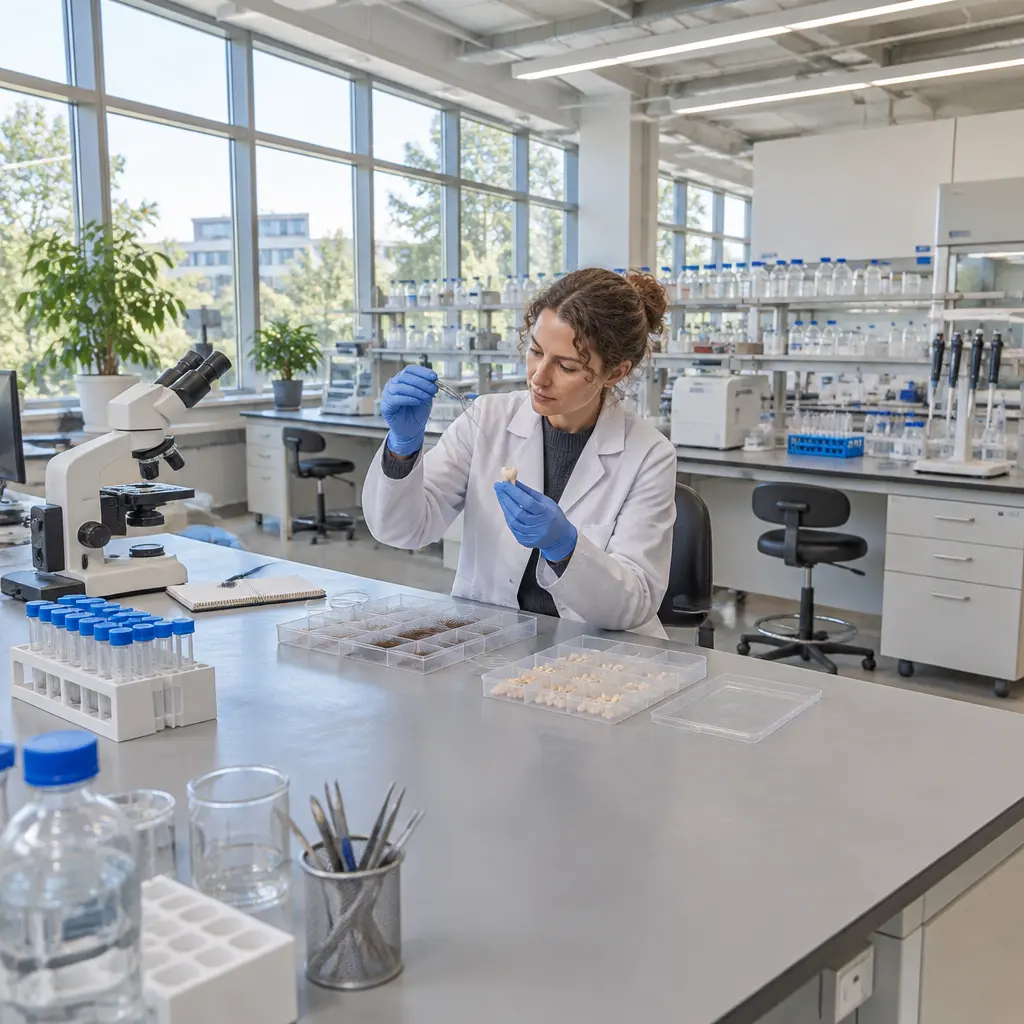
Carbon Source Selection Choosing Meaningful Origins Like Hair Or Baby Teeth
Carbon-source selection in radiocarbon dating means choosing a sample whose carbon reliably represents the event being studied. Hair and baby teeth can be meaningful sources because they preserve biological information from particular periods of a person’s life—but neither automatically dates a death or event. Hair records the period when it grew, while tooth tissues form at different stages of childhood. Researchers therefore match the sample and tissue to the question, check for contamination and dietary effects, and interpret the result alongside other evidence. This matters because radiocarbon results are measurements of carbon fixation, not direct calendar dates: calibration and careful sample choice are essential for a defensible conclusion.
Radiocarbon Sample Selection: What Makes an Origin Meaningful?
Radiocarbon dating estimates the time since carbon in once-living material stopped exchanging with the environment. The method relies on carbon-14, a radioactive isotope produced in the atmosphere and incorporated into plants and animals through food webs. The National Institute of Standards and Technology describes radiocarbon measurement as an isotope-ratio measurement; laboratories compare a sample’s carbon-14 with reference standards and report a radiocarbon age, typically in years before present, where “present” is defined as 1950. That age must then be calibrated against records of past atmospheric carbon-14 to estimate calendar dates.
A meaningful carbon source is one that is demonstrably connected to the event of interest, formed at a known or interpretable time, and preserved without substantial later contamination. Common sample classes include short-lived plant remains, wood, bone collagen, tooth tissues, hair, charcoal, and marine or freshwater organisms. These materials answer different questions: a seed may date a harvest or deposit, while hair or a developing tooth may help reconstruct an individual’s diet or life history. The key is to date the carbon-bearing material that most directly represents the event, rather than simply the most accessible object.
Radiocarbon Dating: Carbon-Source Selection and Sample Meaning
The International Atomic Energy Agency explains that radiocarbon dating is based on the decay of carbon-14 after an organism stops taking in carbon. In practice, selection is a chain of reasoning: identify the event, determine when the sample’s carbon entered the tissue, establish whether the organism’s carbon source could have been offset from the atmosphere, and assess preservation and laboratory pretreatment. A result can be analytically precise yet poorly related to the event if the chosen material formed earlier, contains old carbon, or was contaminated.
Important sample-selection hyponyms include direct dating, in which the material belonging to the person or object is measured; associated dating, in which nearby material is used to estimate context; and sequential sampling, in which growth layers or tissues are measured separately. Hair and teeth are especially useful for direct, person-centered questions, but they differ in how their timelines are recorded.
Direct dating and association
Direct dating measures the target material itself—for example, collagen from a person’s bone or carbon from a lock of hair. Associated dating measures an item found with the target, such as charcoal in a burial layer. Direct dating generally strengthens the link between measurement and subject, but it does not remove the need to understand tissue formation and diet. Associated samples may be older or younger than the event because deposits can contain residual or intrusive material.
The International Commission on Radiocarbon Dating and related laboratory guidance emphasize that contextual integrity matters: a date is only as informative as the association between the dated sample and the event. For a suspected burial, for example, dating human tissue can test the individual’s age, while a nearby wooden object may have been made from timber that grew long before burial.
Radiocarbon age, calibration, and uncertainty
A conventional radiocarbon age is not the same as a calendar age. Atmospheric carbon-14 has varied through time, so laboratories calibrate measurements using internationally maintained curves. IntCal20, developed by an international team and published in 2020, covers terrestrial Northern Hemisphere samples back to 55,000 calendar years before present; separate curves are used for other reservoirs and regions. Calibration can yield a range or multiple possible calendar intervals rather than one exact year.
For readers comparing results, the laboratory’s stated uncertainty, calibration curve, confidence interval, and sample pretreatment are important. A result reported as a radiocarbon age with a small measurement error is not necessarily an equally narrow calendar date. Calibration-curve shape and reservoir effects can broaden or split the calendar range.
Hair: A Short-Term Record of Carbon Intake
Hair is keratin produced in follicles. Once a segment has grown beyond the scalp, it is metabolically inactive, so its carbon largely reflects the body’s inputs during the period of growth rather than the person’s diet at death. The American Academy of Dermatology gives an average scalp-hair growth rate of about half an inch per month, although individual rates vary. This makes a long hair shaft potentially useful for studying changing diets or movements over months, provided the segment’s position and growth timing are understood.
Hair has two distinct uses that should not be confused. Stable-isotope analysis of carbon-13 and nitrogen-15 can help investigate diet and mobility, while radiocarbon analysis of carbon-14 can estimate when the hair’s carbon was fixed. A hair result dates the growth of that segment, not necessarily the person’s birth, death, or the moment the hair was cut.
Segmented hair and life-history questions
Segmental analysis divides a strand into sections from root to tip. Because newer hair is closer to the scalp and older hair is farther away, researchers may compare segments to investigate changes in diet or exposure. A well-known example is the study of Ötzi the Iceman, whose hair and other tissues were examined to reconstruct aspects of his diet and life. Such analyses illustrate hair’s value as a sequential biological archive, but they also show why the sampled segment, growth assumptions, and analytical method must be reported.
For radiocarbon dating, hair is most informative when researchers need a direct sample from a person and can establish that the shaft is genuine, securely associated, and not treated with carbon-bearing products. Hair dyes, oils, conservation materials, soil organics, and handling can introduce contaminants. Laboratories use cleaning and pretreatment procedures, but these cannot make every compromised sample reliable.
Hair limitations and dietary offsets
Hair carbon reflects the foods and environmental carbon entering the person, so a diet rich in marine foods can carry an apparent radiocarbon age older than the atmosphere. Marine organisms draw carbon from ocean reservoirs that exchange with the atmosphere slowly; the resulting marine reservoir age varies by region and time. Freshwater fish can also produce offsets, sometimes substantial and locally variable, through the freshwater reservoir effect.
Consequently, a hair date should not be interpreted as a straightforward calendar date without considering diet and geography. Researchers may use stable isotopes, archaeological context, and appropriate reservoir corrections to assess the likely offset. When dietary history is unknown, a precise measurement can still support only a qualified interpretation.
Baby Teeth: A Layered Record of Childhood Carbon
Baby teeth, or deciduous teeth, form during early life and retain tissues created at different stages. Enamel is mineralized during tooth formation and is generally more resistant to chemical change than bone, while dentine forms incrementally and may preserve a developmental timeline. The American Dental Association reports that primary teeth begin emerging at around six months of age and that most children have all 20 primary teeth by about age three. These eruption dates are not the same as formation dates: a tooth’s tissues begin developing before it appears in the mouth.
A tooth can therefore be meaningful when the research question concerns childhood diet, breastfeeding and weaning, migration, or the timing of early-life carbon intake. However, a tooth does not automatically provide the date of death. Its tissues record the period in which they formed, and later exposure or alteration can affect some components differently.
Enamel and dentine formation
Enamel is the highly mineralized outer layer of a tooth and is often used for elemental and isotope studies because it is comparatively resistant to post-burial change. Dentine forms beneath enamel and can preserve growth increments; unlike enamel, it contains organic material that may be susceptible to degradation or contamination. Researchers select tissue according to the question and the preservation state rather than treating the whole tooth as a single timestamp.
The timing of tooth development is tooth-specific. A primary incisor and a primary molar do not record precisely the same developmental window. Developmental charts from dental research can help estimate when a tissue formed, but individual variation and the sampled location within the tooth should be acknowledged. Where sufficient material is available, sampling growth increments can provide a more detailed sequence than measuring a bulk tooth sample.
Breastfeeding, weaning, and carbon-source shifts
Tooth tissues can capture changes in early diet. Stable-isotope research has used nitrogen-isotope patterns to investigate breastfeeding and weaning because nursing infants receive nutrients through a trophic relationship similar to eating higher on the food chain. Carbon isotopes can add information about food sources and dietary transitions. These methods are not identical to radiocarbon dating: stable isotopes characterize diet, while carbon-14 is used to estimate the age of carbon. Combining them can help assess whether a radiocarbon offset may be present.
A case study by researchers studying ancient human remains in the Pacific and other regions illustrates why childhood tissues can be valuable: tooth chemistry has been used to investigate movement and dietary transitions that are not visible from adult skeletal remains alone. The interpretation depends on matching each tissue’s formation period to the life-history question and accounting for local foods and environmental baselines.
Tooth preservation and contamination
Burial conditions can alter teeth. Groundwater, conservation adhesives, consolidants, and adhering soil may affect measurements, especially when the target is an organic fraction. Laboratories commonly inspect samples, remove surface contamination, and isolate the relevant carbon-bearing component. The method must be suitable for the material: a radiocarbon date on an appropriate organic fraction is not interchangeable with a date on carbonate unless the analytical question and pretreatment are clearly justified.
Sample size is also a practical constraint. Radiocarbon laboratories may need a minimum amount of carbon, and destructive sampling can consume irreplaceable material. Researchers should consult the laboratory before sampling and document the tooth identity, tissue sampled, pretreatment, and any conservation history.
Choosing Between Hair and Baby Teeth
Hair is often preferable when the question concerns a recent segment of an individual’s life or when a direct, minimally invasive sample is available. Baby teeth are more appropriate for questions about childhood formation and early-life diet, especially when tissue-specific sampling can isolate a developmental interval. Neither is universally superior; the best material is the one whose formation period and carbon pathway most closely match the event being tested.
- For a question about an individual’s final months or years, consider hair only if the sampled segment can be securely linked to the relevant period.
- For a question about infancy or childhood, identify the tooth and tissue, then consult developmental timing evidence.
- For either material, assess marine or freshwater dietary contributions, preservation, handling, and conservation treatments.
- Use contextual samples as supporting evidence, not as substitutes for a direct date when direct material is available and ethically permissible.
- Ask the radiocarbon laboratory about sample quantity, pretreatment, contamination risks, and calibration before destructive sampling.
A useful visual summary would be a timeline comparing hair growth along a strand with enamel and dentine formation in a primary tooth. Such a chart should label the tissue’s formation window separately from the person’s death or burial date to prevent readers from treating biological records as event timestamps.
Conclusion: Match the Carbon Source to the Question
Radiocarbon sample selection is strongest when the material’s origin, formation period, and carbon pathway are understood. Hair can preserve a relatively short-term record of carbon intake, while baby teeth preserve childhood tissues formed at different developmental stages. Both can support meaningful research, but diet-related reservoir offsets, contamination, tissue formation, calibration, and uncertainty must be addressed.
Before interpreting or collecting a sample, define the event to be dated, select the tissue that most directly represents it, and consult a qualified radiocarbon laboratory. For further reading, review the IntCal calibration resources, radiocarbon laboratory guidance, and dental development literature. Careful selection protects both the scientific validity of the result and the long-term value of rare human remains.
Sources: National Institute of Standards and Technology, Radiocarbon Dating and Isotope Measurement Resources, https://www.nist.gov/; International Atomic Energy Agency, Radiocarbon Dating, https://www.iaea.org/topics/radiocarbon-dating; Reimer, P. J., et al., “The IntCal20 Northern Hemisphere Radiocarbon Age Calibration Curve (0–55 cal kBP),” Radiocarbon, 2020, https://doi.org/10.1017/RDC.2020.41; American Academy of Dermatology, Hair Loss: Diagnosis and Treatment, https://www.aad.org/public/diseases/hair-loss/treatment/diagnosis-treat; American Dental Association, Baby Teeth, https://www.mouthhealthy.org/all-topics-a-z/baby-teeth; Hedges, R. E. M., “Bone Diagenesis: An Overview of Processes,” Archaeometry, 2002, https://doi.org/10.1111/1475-4754.00064; Bronk Ramsey, C., “Bayesian Analysis of Radiocarbon Dates,” Radiocarbon, 2009, https://doi.org/10.1017/S0033822200033865.